

Tutoring business software for tutors who think like entrepreneurs
You're not just giving lessons, you're running a business. But your tools don't reflect that. You manage students in a spreadsheet, schedule via WhatsApp, and teach on Zoom. Teamlilit gives you the infrastructure to run tutoring like the business it is: one platform for scheduling, students, lessons, attendance, billable hours, and invoices.
Your current stack

What a business needs that a lesson tool doesn't give you
Most tutoring tools are built around the lesson. That is the easy part. The parts that decide whether tutoring pays are the ones nobody sells you software for:
- Capacity. How many teaching hours can you actually sell next month, and how many of them are already booked?
- Cash. What was taught, what was billed, what was paid, and what is quietly overdue?
- Retention. Which students are drifting before they cancel, and which ones have a reason to book again?
- Leverage. What happens to all of this the day you stop being the only tutor?
Teamlilit is built so those four questions have answers you can read instead of reconstruct. The day-to-day machinery lives on our tutoring management software page. This page is about the business you build on top of it.
The day-to-day, handled
The operational layer is the foundation, and it should be boring. In one platform you get scheduling with recurring sessions, student profiles with full lesson history, automatic attendance with join and leave times, a built-in live classroom with whiteboard and screen sharing, and structured courses and programs for students who need a roadmap rather than a string of ad-hoc hours.
None of that is re-entered anywhere. The booking becomes the class, the class becomes the attendance record, and the attendance record becomes the invoice line. That single chain is what makes the business questions below answerable at all.
Filling the calendar
Revenue in tutoring is a capacity problem before it is a pricing problem. An empty Tuesday costs you the same whether you charge $30 or $80.
Publish a booking page on your own link and let students and parents claim the slots you have opened, inside the availability rules you set. Bookings are checked against your existing sessions and the student's own, so a double-booked hour is refused instead of discovered on the day, and everything syncs to Google Calendar. A warm referral turns into a booked lesson while the parent is still motivated, rather than dying in a thread you forget to answer.
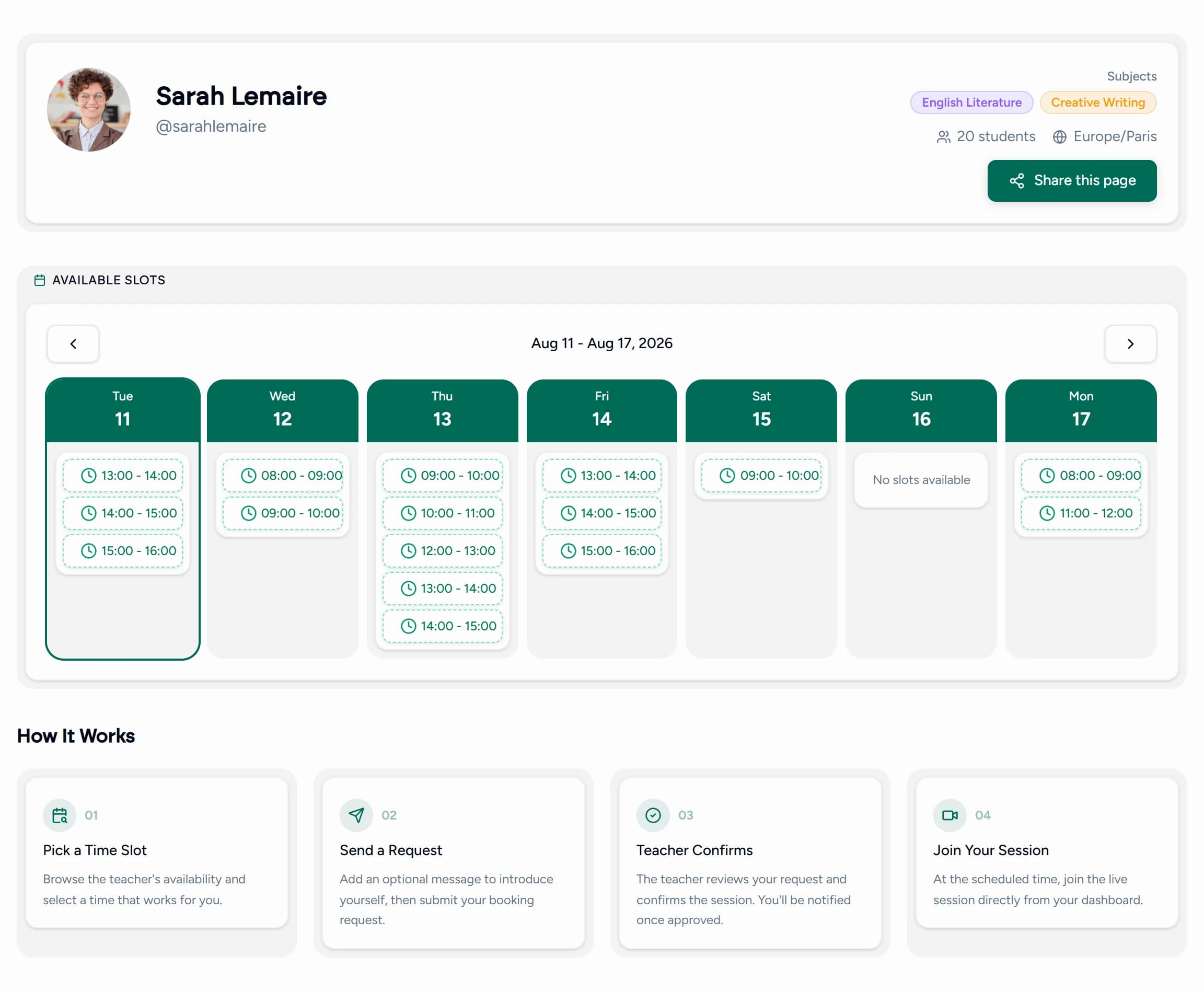
Once the slots are bookable, the job is demand. Our playbooks on how to get more tutoring students, the best marketing channels for tutors, and turning happy students into referrals and reviews cover the growth side. If you are starting around a day job, five steps to start a tutoring business while working full time is the sequencing guide.
Keeping the students you already have is cheaper than replacing them. Automatic email reminders cut the accidental no-shows, attendance records turn a drifting student into a visible pattern before they cancel, and structured programs give families a reason to book the next block. Our guide on how to retain tutoring students covers the rest.
Getting paid without chasing
Teaching the hour and being paid for the hour are two different jobs, and the second one is where independent tutors leak money. Teamlilit closes the gap by building the bill out of what was actually taught.
Generate from tracked sessions
Pick a student and a billing period
3 attended sessions found
- Algebra, GCSE higherTue 3 June, 16:001.5h
- Calculus revisionTue 10 June, 16:00Estimated1.0h
- Exam practice paperTue 17 June, 16:002.0h
Because time is tracked per student against every session, invoicing is a read, not a reconstruction. Pick a period, and the attended sessions and their real durations are already there. On top of that, in-app invoicing handles the things that make tutoring billing awkward:
- Per-student rates, so a GCSE hour and an A-level hour are not forced to the same number
- Consolidated family invoices, billing two or three siblings to one payer on one invoice, with a sibling discount applied
- VAT, inclusive or exclusive, snapshotted onto each invoice
- Automatic late fees on overdue invoices, so the awkward reminder is a rule rather than a conversation
- Monthly recurring schedules that prepare each student's draft invoice for you every period, ready to review and send rather than issued behind your back
- Account credit, credit notes, and statements for prepaid blocks, corrections, and the "what do I actually owe you?" question
One point worth being clear about: Teamlilit never processes your money. The invoice carries your payment details, your bank transfer instructions or your own Stripe or PayPal link, and parents pay you directly. You record the payment when it lands and the invoice moves to paid. No platform cut, no waiting on a payout.
For the full cycle from per-student rates through to payment tracking, see tutor billing software, or the deeper walkthrough on billing and CRM for your tutoring business. Our guides on tracking billable hours and keeping more of what you earn cover the habits around the software.
The math of growing a tutoring business
The lever that changes a tutoring income is rarely "work more hours". It is earning more per hour on the calendar and keeping students longer.
Here is that principle as a worked example. These are illustrative figures for a tutor who moves part of a 1:1 roster into group classes and structured programs, not a forecast of your results:
| Solo 1:1 only | With groups and programs | |
|---|---|---|
| Teaching hours/week | 20 | 15 |
| Students served | 20 | 60 |
| Effective rate/hour | 1 student paying | 3 to 4 students paying the same hour |
| Booking pattern | Week to week | Committed multi-session blocks |
| Admin | Rebuilt by hand each month | Read off tracked sessions |
The shape of the argument holds regardless of your numbers: a group hour is sold several times, and a program turns a rolling weekly booking into a committed block. Your actual figures depend on your rates, subject, and market.
Want the real version instead of the illustration? Run your own with the free tutor earnings calculator, and if you are not sure what to charge in the first place, our guide to pricing your online tutoring sessions benchmarks current rates by region and level.
Your growth path
Solo (€29/mo)
You're an independent tutor with a handful of students. You need scheduling, a classroom, and student records that stay current. This is the foundation, and for many tutors it is also the destination.
Pro (€69/mo)
Your business is growing. You are running group classes alongside 1:1, your roster is bigger, and admin has started to cost real evenings. Pro is the tier where the platform starts saving you more time than it takes.
Academy (€119/mo)
You've hired other tutors. Now the problem is coordination: every tutor's timetable, students shared across the team, and one place to see what the whole operation is doing. See tutoring centre software for how that dashboard works, and pricing for what each tier includes.
Every plan starts with a 14-day free trial, no credit card. There is no permanently free tier, and moving between plans carries your students, classes, and history with you.
When you add your first tutor
Hiring changes the failure mode. As a solo tutor, the risk is that you forget something. With a team, the risk is that two people hold different versions of the truth.
On the Academy plan, tutors get their own logins and timetables, student records live in the academy rather than in one person's account, and an admin sees every tutor's schedule, attendance, and billable hours from one dashboard. Billable time is recorded the same way for every tutor, which is what makes paying them and billing families the same clean read.
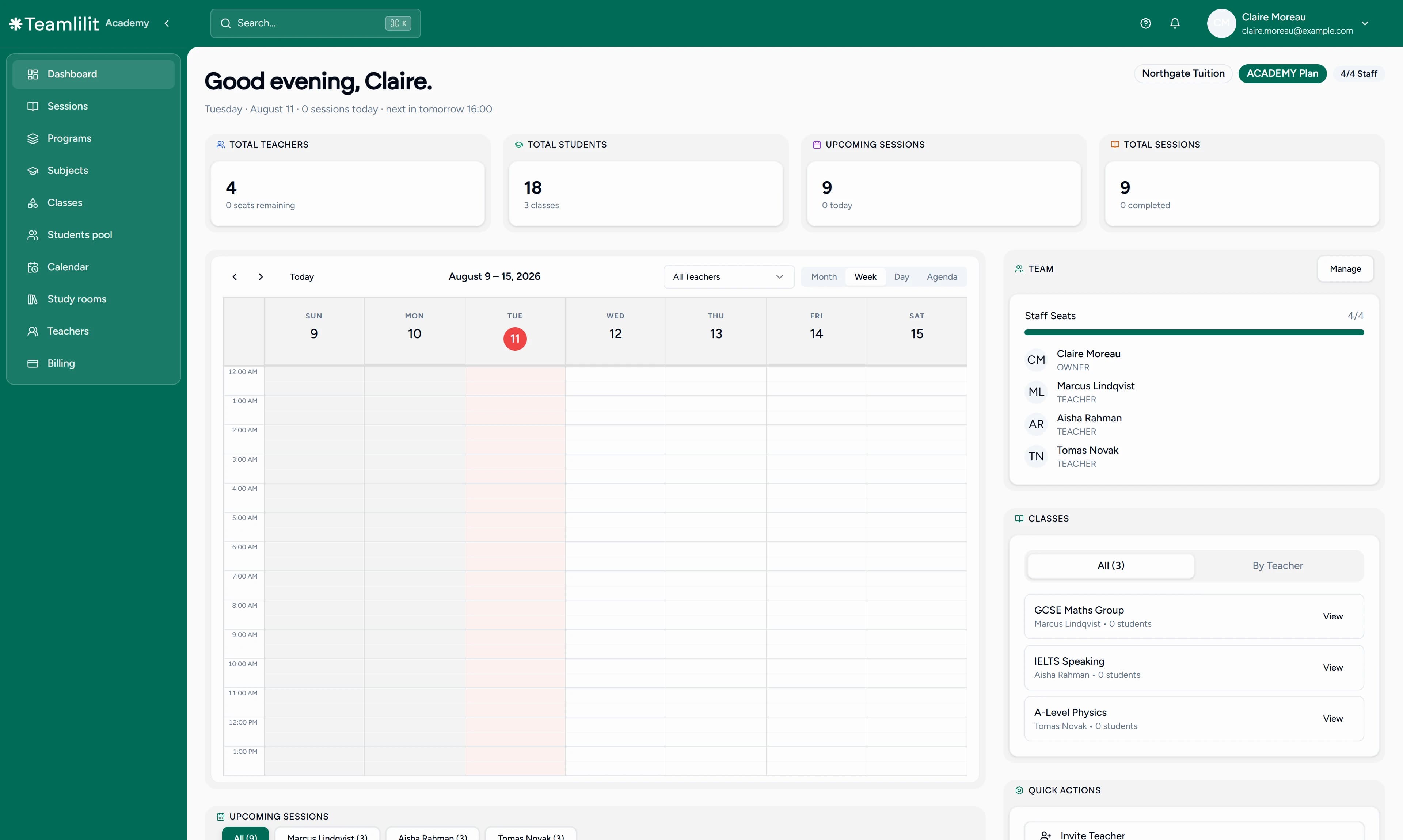
Worth setting expectations honestly: Academy means many tutors in one organisation. It is not multi-site or multi-branch management, and Teamlilit does not book or clash-check physical classrooms. If your growth plan is a second building rather than a second tutor, that gap matters and you should know it now.
Who switches to Teamlilit
- Solo tutors who realise they're spending more time managing logistics than teaching
- Tutoring agencies that outgrew spreadsheet-based operations
- Academy owners who need to manage several tutors and keep quality consistent
- Side-hustle tutors who want to look professional from day one
- Returning tutors rebuilding a roster after a break and wanting the system right this time
Try the numbers before you commit
You can start getting the business side in order before you sign up for anything. These free tools need no account:
- Tutor earnings calculator: work out what your week actually pays after hours, rates, and gaps
- Tutoring hours tracker: log lesson time, billable hours, and cancellation fees, then export them
- Tutor invoice maker: turn lesson history into a professional, UK-compliant invoice PDF
If those tools show you a business worth systematising, that is exactly what the platform automates. For the relationship side of the roster, tutor CRM software covers follow-ups and pipeline.
Frequently asked questions
How is this different from tutoring management software?
They are two views of the same platform. Tutoring management software is about running the teaching week: scheduling, attendance, lesson records, and the live classroom. Tutoring business software is about what sits on top of that: what your hours are worth, whether the money owed actually arrives, how full next month looks, and what changes when you add a second tutor. If you mainly want the day-to-day system, start on the tutoring management software page. If you are making decisions as the owner, start here.
How much does it cost?
Solo is €29/mo for individual tutors. Pro is €69/mo once you are running groups and a fuller roster. Academy is €119/mo for multi-tutor operations. Prices are shown in your own currency. Every plan starts with a 14-day free trial and no credit card, and you can move up a tier without rebuilding anything. See pricing for the full comparison.
What changes when I hire my first tutor?
You move to the Academy plan for multi-tutor tutoring businesses and the business stops living in your head. Other tutors get their own logins and timetables, students and records are shared inside one academy instead of one person's account, and an admin can see every tutor's schedule, attendance, and billable hours from a single dashboard. Academy means many tutors in one organisation; it is not multi-site or multi-branch management, and Teamlilit does not book physical rooms.
Does Teamlilit handle invoicing and payments?
It handles invoicing, and it tracks payment, but it never touches your money. Invoices are built from the sessions and time already tracked against each student, with VAT, per-student rates, family discounts, and automatic late fees. The invoice carries your own payment details, your bank transfer instructions or your own Stripe or PayPal link, so parents pay you directly. When the money arrives you record it and the invoice moves to paid. There is no Teamlilit checkout in the middle and no cut taken.
Can I charge different students different rates?
Yes. Rates live on the student, not on a single global setting, so a GCSE hour and an A-level hour can be priced differently and a long-standing student can keep an older rate. Siblings can be billed on one consolidated invoice with a family discount applied, and account credit and credit notes handle prepaid packages and corrections.
Can students book their own lessons?
Yes. You publish a booking page at your own link, set the hours you are actually willing to teach, and students or parents book inside those rules. Bookings are checked against your existing sessions and the student's, so clashes are refused rather than discovered later, and everything syncs to Google Calendar. It is the difference between filling next week and negotiating it over WhatsApp.
Is there a free trial?
Yes. Every plan starts with a 14-day free trial and no credit card. There is no permanently free tier: the trial is long enough to set up your students, run real lessons, and send a real invoice before you decide.
Do I need technical skills to set it up?
No. Create your workspace, add your students, publish your availability, and schedule the first session. Most tutors are teaching in the system the same day and add billing once the schedule is running.
Build a tutoring business, not a tutoring hobby
If you're serious about tutoring, use serious tools. Start the 14-day free trial on the Solo plan, add your students, and send your first invoice from a real lesson. See pricing for plan details.
